
Construction RAMS: What Contractors Need to Know Before Starting Work
RAMS — risk assessments and method statements — are a core part of planning construction work safely. For small and medium contractors, subcontractors and growing businesses, they are often requested before a client or principal contractor will allow work to start. They may also be needed for a tender, PQQ submission, site induction or a live project where the planned work has changed.
Good construction RAMS should reflect the actual work, site conditions and controls available to the team. They should help people understand the risks and safe system of work, while giving clients and principal contractors confidence that the arrangements have been properly considered. Where support is needed, Toolbox Consult can provide RAMS preparation and review for contractors.

What RAMS Are and Why Contractors Need Them
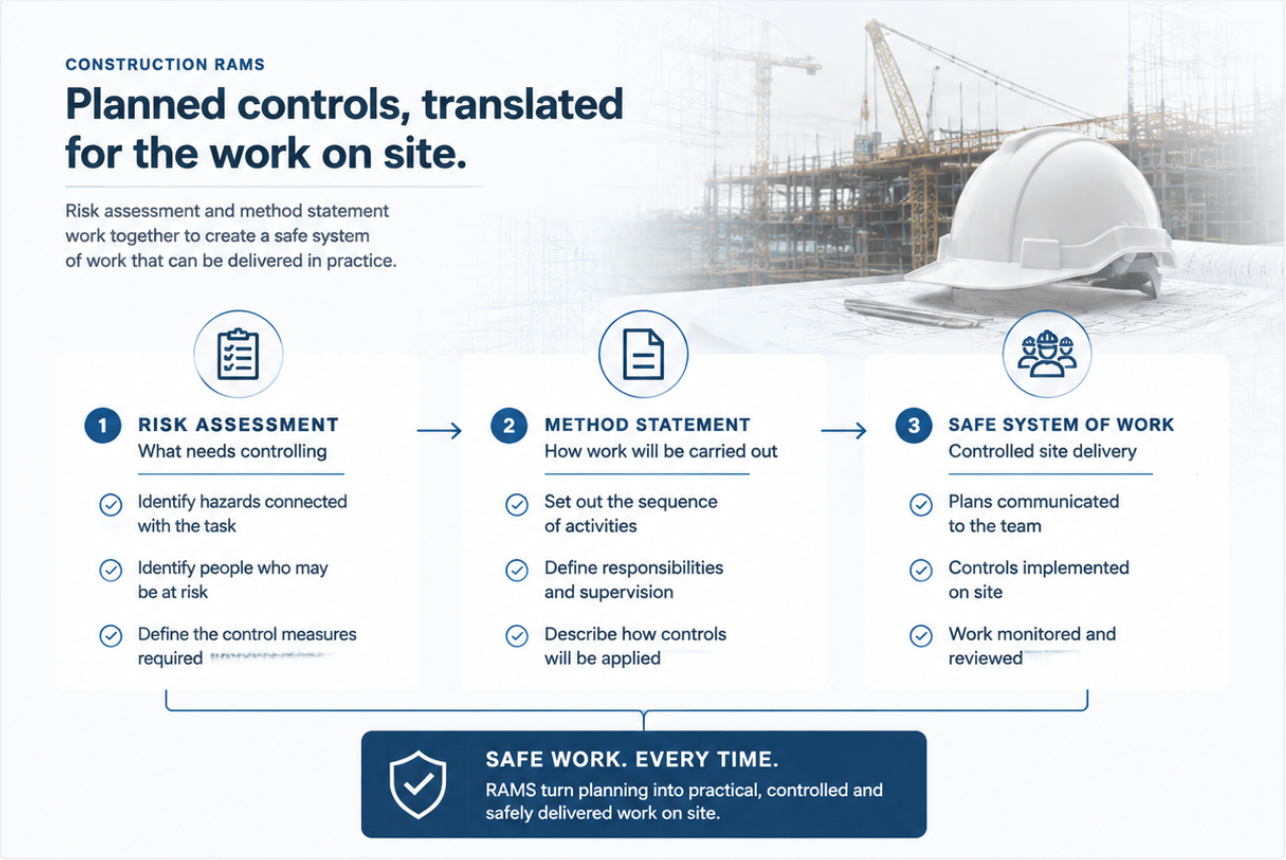
RAMS means risk assessments and method statements. Together, they set out the hazards connected with a task, the controls needed to manage those hazards and the planned sequence for carrying out the work safely. Construction RAMS should be site-specific: a document used for one project may not be suitable for another where the task, programme, access, interfaces or controls differ.
Construction clients and principal contractors commonly ask for RAMS to check that subcontractors have considered the work before arriving on site. A suitable document can support a smoother start, help brief operatives and provide evidence that the contractor has considered foreseeable risk and the practical arrangements needed to control it.
This is especially important where work involves higher-risk activities such as work at height, hot works, lifting operations, excavations, temporary works, electrical isolation, silica dust, plant interfaces or occupied premises.
The Difference Between a Risk Assessment and a Method Statement
A risk assessment identifies the hazards associated with the work, who could be affected and the controls required to reduce risk to an acceptable level. It should be specific to the activity and realistic about the conditions on site.
A method statement explains how the work will be completed. It should set out the sequence of operations, responsibilities, materials, plant, access arrangements, permits, supervision, emergency arrangements and checks needed to apply the controls in practice.
In simple terms: the risk assessment explains what could cause harm and how it will be controlled; the method statement explains how the team will carry out the work safely.
Common RAMS Mistakes That Cause Client Rejection or Delays
- Using generic documents that do not match the site, task, programme or client requirements.
- Missing key risks, including work at height, plant and people segregation, lifting, dust, services or emergency arrangements.
- Setting out controls that are vague, impractical or not available to the team doing the work.
- Not checking the principal contractor's site rules, permit systems, logistics plan or construction phase plan.
- Leaving out competence, supervision, training, inspection and maintenance requirements.
- Failing to brief operatives or update the RAMS when the scope, sequence or site conditions change.
What Good RAMS Should Contain
The detail should be proportionate to the work, but strong construction RAMS normally include a clear description of the scope, named responsibilities, relevant risk assessments and a method statement that reflects the actual work sequence. They should also identify who will review changes and how the arrangements will be communicated to the people carrying out the work.
- Project and task details, including interfaces with other trades and site restrictions.
- Relevant hazards, people at risk and specific control measures.
- Plant, equipment, access arrangements, PPE and any inspections or pre-use checks.
- Competence, training, supervision and communication arrangements, including access to competent person support where appropriate.
- Permits, isolations, welfare, emergency procedures and incident reporting arrangements where relevant.
- Briefing, review and change-control arrangements so the document remains live throughout the work.
When Contractors Should Seek External Support
External support can be useful where RAMS are needed quickly for a tender or mobilisation, where the work is higher risk, where a client has rejected earlier documents, or where the business does not have sufficient internal health and safety capacity. It can also help where contractors need evidence for SSIP accreditation preparation or wider client pre-qualification requirements.
It is also valuable when a contractor wants someone to challenge whether controls are genuinely workable on site, rather than simply supplying a document. The best outcome is RAMS that support delivery, help management understand the risks and give the client confidence in the contractor's arrangements. Regular site audits and inspections can then help confirm whether those controls are being applied in practice.
Related consultancy support
Practical consultancy support
Need Practical Construction RAMS Support?
Toolbox Consult can prepare or review project-specific RAMS and provide wider construction health and safety support where your business needs additional capacity.
- RAMS development and review
- PQQ and tender support
- Wider construction H&S assistance